


The conquest of Istanbul by the Ottomans in 1453 marked not only the end of an empire, but also a critical turning point for Byzantine art—particularly for the tradition of iconography.
Master icon painters working in the city’s wealthy monasteries, imperial workshops, and churches set sail for new destinations following the establishment of Ottoman rule. Most notably, many settled on islands close to Ottoman territories and in Italy, where they transformed their art into an entirely new synthesis.
A significant number of icon painters who migrated from Istanbul settled on the island of Crete, which at the time was under the rule of the Venetian Republic.
These masters combined the traditional techniques of Byzantine icon painting with the Renaissance Italian understanding of perspective, figuration, and composition. As a result, a new iconographic style—known as Italo-Cretan (Italo-Critic)—emerged, blending the spiritual depth of the East with the naturalistic attention to detail of the West.
While traditional Byzantine icons emphasize gold-leaf backgrounds, symbolic figures, and rigid compositional schemes, the Italo-Cretan style is characterized by:
- The use of perspective becomes more pronounced.
- Anatomical details are rendered in a more naturalistic manner.
- Landscape and architectural backgrounds add depth to the compositions.
- The decorative influence of Venetian workshops becomes evident in the ornamentation of icons.
This synthesis did not remain confined to Crete alone; it spread to the Ionian Islands, the Adriatic coast, and Orthodox communities throughout the Balkans.
With the conquest, not only painters but also numerous sacred objects inherited from Byzantium—icons and relics—were transferred to Italy. Venice in particular, along with Ravenna, Bari, and other port cities, became major centers of new icon workshops and Orthodox communities. These cities functioned as cultural bridges, carrying the artistic legacy of Byzantium into the Western world.
Today, Italo-Cretan icons can still be found in monasteries in Greece, churches in Crete, and certain Orthodox churches in Venice.
For art historians, these works represent some of the most tangible evidence of how Byzantium’s visual language intertwined with the world of the Renaissance.
The principal elements inherited from the classical Byzantine tradition include:
- Gold Backgrounds: Gold-leaf grounds, conceived as earthly reflections of the divine realm, remove figures from the secular dimension.
- Symbolic Postures of Saints: Saintly figures making gestures of blessing or depictions of Christ holding the Gospel are typical.
- Frontal, Flat Composition: Icons are perceived as “windows,” with figures rendered in an idealized and non-naturalistic manner.
- Scriptural Inscriptions: The names of saints are generally written in Greek or Old Church Slavonic.
Italo-Cretan icons, by contrast, adopt the following elements from Venetian and Italian art:
- Perspective and Depth: Backgrounds featuring rocks, mountains, or cityscapes create a three-dimensional spatial effect.
- Figurative Naturalism: Shading in facial features and detailed anatomical modeling become more prominent.
- Use of Color: While the vibrant combination of red, green, and gold tones is inherited from Byzantium, Western influence introduces greater movement and dynamism in the figures’ garments.
- Narrative Scenes and Details: Miniature-like scenes surrounding the central figure—such as miracles or episodes from a saint’s life—are used to construct a visual narrative.
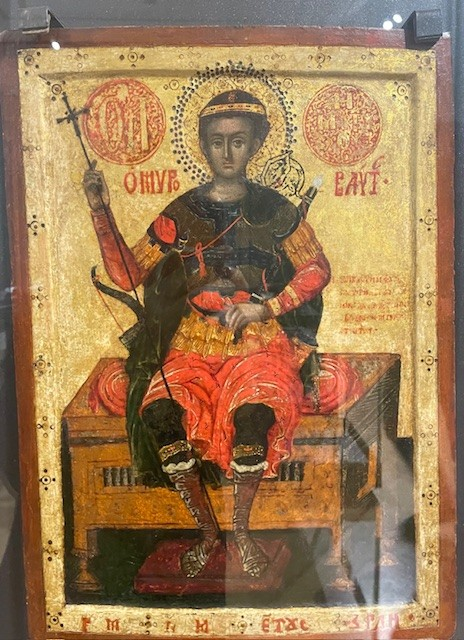
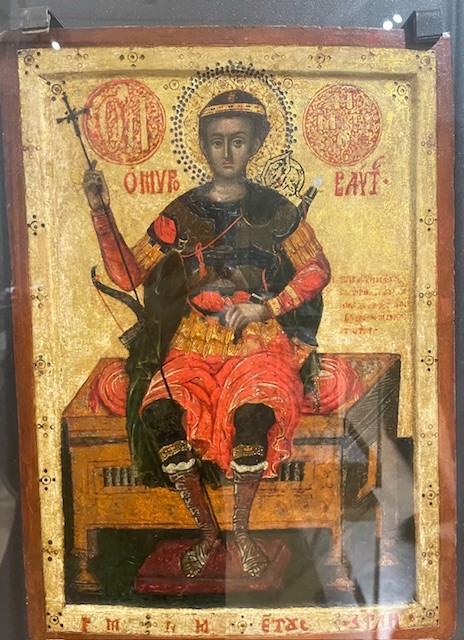
Seated on a throne against a gold-leaf background, a youthful warrior saint clad in a red tunic and armor holds a cross of faith in his right hand and the hilt of a sword in his left.
Facing the viewer frontally, this figure combines the themes of victory and protection central to the Eastern Orthodox icon tradition with the naturalistic attention to detail characteristic of Western art.
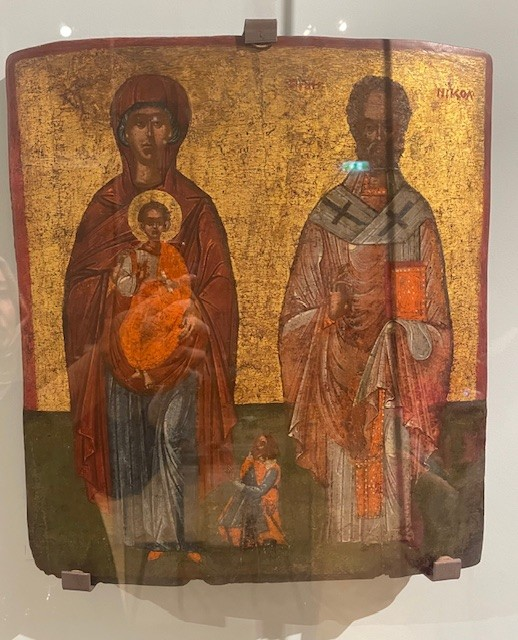
This icon depicts the Virgin Mary standing beside the Christ Child in her arms, alongside a bishop saint on the right, all set against a gold-leaf background.
The Virgin is rendered in accordance with the Theotokos tradition, wearing a red mantle over a dark blue tunic. The Christ Child, seated in her lap, raises his right hand in a gesture of blessing while holding what is likely a Gospel book in his left.
The bishop saint on the right is identifiable by his short beard, the cross-decorated omophorion draped over his shoulders, and the closed Gospel book he holds; he most likely represents Saint Nicholas or a comparable episcopal saint. The figures stand upon a green ground, a detail that emphasizes the boundary between the earthly realm and the sacred space.
Beneath the two principal figures, a smaller kneeling figure appears at the center—symbolizing either the donor who commissioned the icon or a praying believer. The frontal and symmetrical arrangement of the figures, the sanctity conveyed by the gold background, and the subtle red-toned modeling together clearly demonstrate how the Byzantine icon tradition was fused with Renaissance naturalism within the Italo-Cretan workshops.
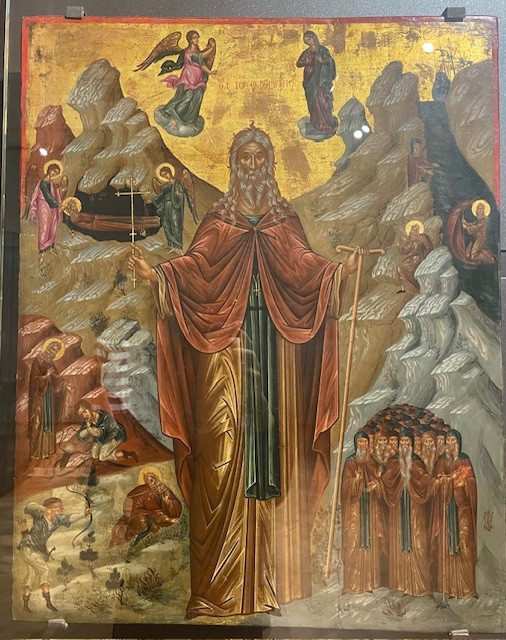
This icon centers on a monumental saint—most likely a venerable hermit monk—set against a mountainous landscape.
Long-bearded and encircled by a halo, the saint is clad in a broad brown monastic robe and holds a cross in one hand and a long staff resembling a walking stick in the other, symbolizing both spiritual authority and the struggle of faith. While the gold-leaf background underscores the sacred realm, the rocky mountains introduce depth and narrative complexity to the scene.
In the upper register, angelic figures and miniature landscape scenes appear, representing miracles from the saint’s life or moments of divine inspiration. In the lower left corner, a small figure—possibly engaged in combat with a serpent or undergoing spiritual purification—illustrates the saint’s miraculous power and intercessory role. In the lower right, a group of monks is depicted in a posture of prayer before their leader.
The entire composition, with its frontal presentation of figures, subtle facial modeling, and rich narrative detail, vividly demonstrates how the Italo-Cretan icon tradition merges the profound spirituality of Byzantine art with the pictorial sensibilities of Western painting.
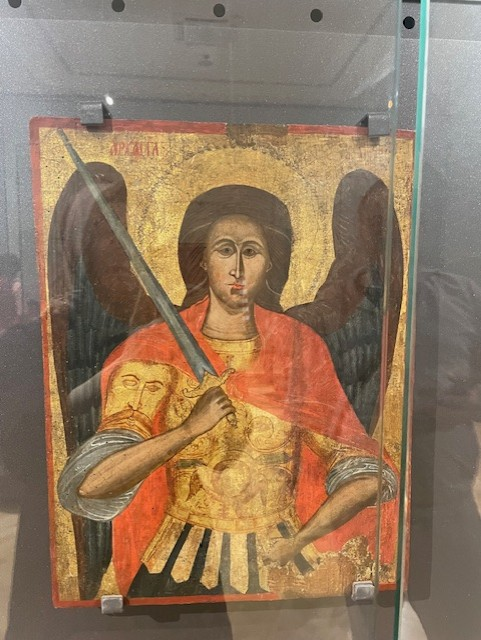
This icon depicts a standing archangel rendered frontally against a gold-leaf background, most likely the Archangel Michael.
A radiant halo surrounds the figure’s head, while large, dark wings dominate the composition—symbolizing the archangel’s role as commander of the heavenly armies and divine protector. Clad in a cuirass and a flowing red cloak, the archangel raises a large sword upward in one hand, a gesture representing his struggle against evil and his embodiment of divine justice and power.
In the other hand, the figure is shown grasping his armor or, in other iconographic variations, holding a globe or shield; here, the detailed rendering of the armor emphasizes a sense of martial strength. The dark tonality of the wings creates a striking contrast with the gold background, reinforcing the archangel’s separation from the earthly realm and his celestial nature.
The solemn facial expression and the direct gaze toward the viewer evoke a sense of divine warning and protection. Such archangel icons occupy a central place in both the Byzantine tradition and the Italo-Cretan schools, where they function as powerful visual representations of the spiritual warrior who safeguards the community of faith against evil.
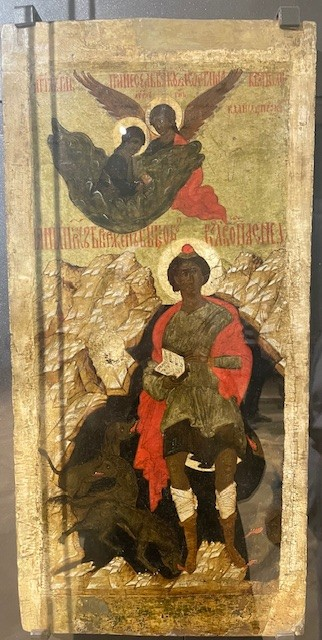
This narrow, elongated icon presents a dramatic miracle or hagiographic scene.
In the upper register, a saintly figure seated among clouds appears with arms opened in a gesture of prayer, accompanied by an angel; this scene signifies heavenly approval and divine protection.
In the lower register, a youthful, beardless saint or hermit occupies the center of the composition. Dressed in a short tunic and cloak, the saint holds a prayer book or scroll in one hand while making a gestural motion with the other, suggesting the act of teaching or the performance of a miracle. Beneath his feet, dark-toned monstrous figures—shown chained or crushed—draw attention; these symbolize the saint’s triumph over evil spirits or demonic forces.
The rocky background implies that the figure dwells in a cave or mountainous ascetic retreat. The angel above reinforces the notion of divine inspiration and sanctification of the saint’s actions. Bright red accents—visible in the saint’s cloak and in the angelic details of the celestial scene—serve as symbols of spiritual victory and sacrificial protection within both Byzantine and Italo-Cretan iconography.
Through this layered composition, the scene conveys at a glance both the saint’s resistance to worldly evil and his unwavering devotion to God.
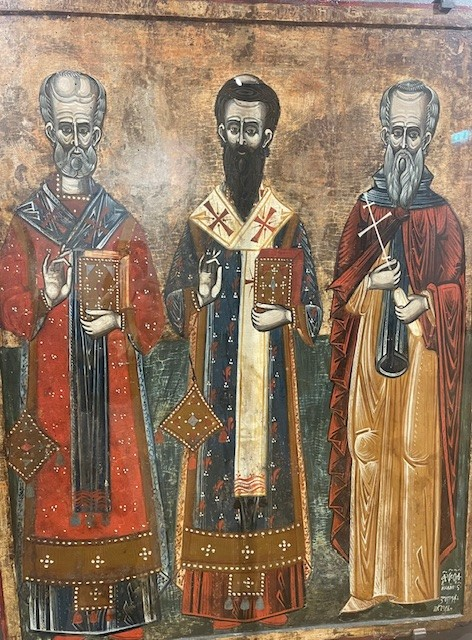
This icon depicts three bishop saints arranged side by side in a frontal and symmetrical composition.
Each figure bears a gold-leaf halo and holds a closed Gospel book, symbolizing the doctrine of the Orthodox faith. Their right hands are raised in a gesture of blessing, representing sanctification and the acceptance of prayers.
The figure on the left, with his white beard, delicate facial features, and predominantly red garments, represents an elderly saint. The central figure, distinguished by his dark beard, richly detailed pallium (cross-decorated omophorion), and deep blue robe, conveys the authority of a powerful patriarch. The figure on the right, with his refined features and the long, cross-like staff or ornamented rod he holds, evokes a more ascetic saintly presence.
The fine embroidery, geometric patterns, and gilded accents of the garments reflect the decorative richness of the Italo-Cretan icon tradition, while the elongated, well-proportioned faces and pronounced contour shading preserve the visual language of Byzantine art. The dark background enhances the prominence of the figures, and the worn surface in the upper portion of the icon reveals the patina of time, underscoring its historical value.
The collective presentation of the three saints signifies a spiritual unity that serves the faithful both as intercessors and as guardians of sacred doctrine.
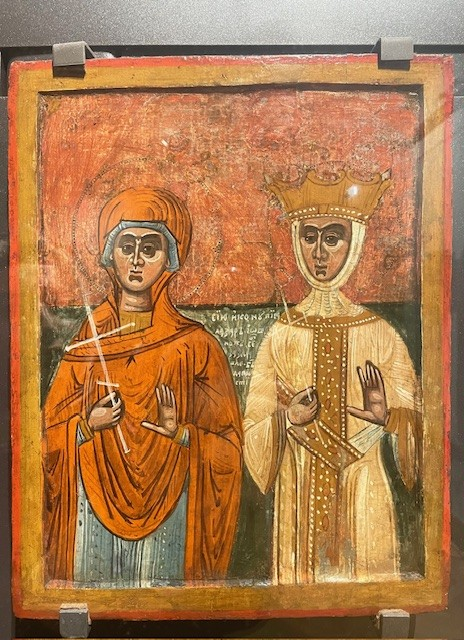
This icon depicts two female saints standing side by side against a red background with a dark green lower band.
The figure on the left represents a martyr saint, identified by her veiled head, simple tunic, and the sword she clasps with crossed arms—a common symbol of martyrdom for female saints who suffered death for their faith. The delicate gold halo encircling her head underscores her sanctity.
The figure on the right wears a large jeweled crown, indicating either royal lineage or her status as a crowned martyr. Both figures are rendered frontally and symmetrically, their composed stances and folded arms conveying a profound sense of spiritual dignity and sacred presence.
The use of white, gold, and red in the garments reflects the color symbolism of the Byzantine icon tradition, where red signifies martyrdom, white denotes purity, and gold evokes divine victory. Inscriptions between the figures identify the saints and include brief prayers.
The textured terracotta-red background adds dramatic depth to the icon, while the fine contour lines and elongated facial features point to the characteristic style of the Italo-Cretan workshops. The scene brings together both the earthly nobility and the spiritual triumph of female sainthood in a unified visual expression.
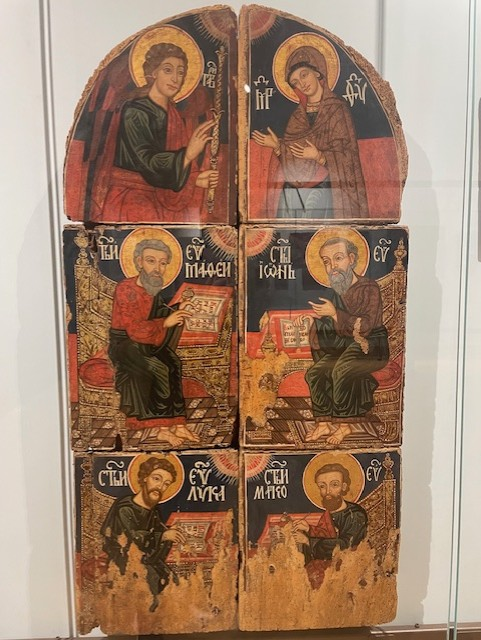
This icon panel presents a unified sacred narrative composed of two arched sections above and four square panels below.
In the upper register, a saintly or Christ figure appears on the left, while the Virgin Mary is depicted on the right; together, these figures evoke the classical scene of the Annunciation, symbolizing the descent of the Holy Spirit upon Mary.
The four lower panels depict the **Four Evangelists—Matthew, Mark, Luke, and John—**shown seated in formal poses. Each evangelist faces the viewer frontally at the center of his panel, raising the right hand in a gesture of writing or prayer, while holding a pen or an open Gospel book in the left. This imagery signifies their divinely inspired mission to transmit the Word of God to the world.
The use of red, green, and gold in the garments reflects the characteristic color palette of both Byzantine icon painting and the Italo-Cretan workshops. The deep blue backgrounds behind the evangelists enhance the prominence of the figures, while embroidery-like decorative patterns evoke the celestial realm.
Signs of wear along the lower edges of the panels attest to centuries of devotional use, particularly through practices of veneration and kissing. This integrated compositional program recalls the Orthodox iconographic understanding of Scripture as having a heavenly origin and emphasizes the role of the four evangelists in disseminating the life and message of Christ through sacred text.
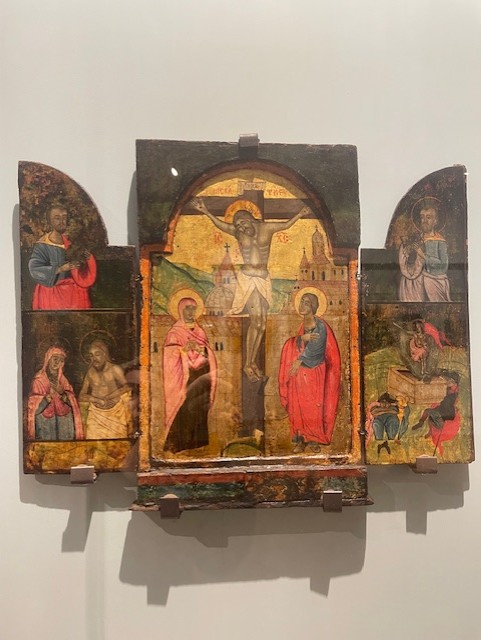
The triptych icon above represents a rich example of the Deesis (Intercession) composition, a format frequently encountered in both Byzantine and Italo-Cretan icon traditions.
In the central panel, Christ Pantokrator (Christ the Almighty) is enthroned in a position of exaltation, raising his right hand in a gesture of blessing while holding an open Gospel book in his left. Immediately to his right stands the Virgin Mary, and to his left John the Baptist; both figures turn toward Christ with inclined heads and outstretched hands in attitudes of intercession.
The side wings feature various saints, angels, or hagiographic scenes. Notably, a warrior saint appears in the upper left panel, while a depiction of Saint George slaying the dragon draws attention in one of the lower sections. The red borders, dark backgrounds, and extensive use of gold leaf emphasize the sacred character of the composition.
In the smaller panel below, the Virgin Mary is seated on a throne-like dais holding the Christ Child in her lap, accompanied by a standing saint. The perspectival tiled floor introduces a sense of spatial depth.
Together, these panels bring together the principal figures of Orthodox iconography—Christ Pantokrator, the intercessory Virgin, John the Baptist, warrior saints, and protective episcopal figures—within a single visual narrative, offering the viewer a sacred “window” intended both for prayer and for spiritual protection.
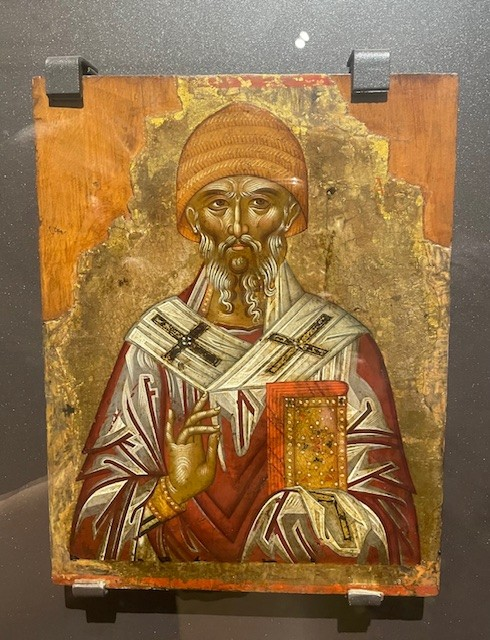
This icon depicts an elderly bishop saint standing frontally against a gold-leaf background.
The figure’s slender face and long, flowing beard evoke the likeness of venerable episcopal saints such as Saint Nicholas or Saint Spyridon. He wears a simple head covering resembling a traditional monastic cap, indicating his connection to both the episcopal office and the monastic tradition. The cross-decorated pallium (omophorion) draped over his shoulders signifies his episcopal rank.
His right hand is raised in the traditional gesture of blessing, symbolizing both adherence to the teachings of Christ and his authority as an intercessor on behalf of the faithful. In his left hand, he holds a closed Gospel book adorned with elaborate jeweled decoration, the detailed motifs of the book’s cover highlighting the icon’s refined craftsmanship.
The pronounced facial contours, the textured rendering of the beard, and the subtle gradations of shadow exemplify how the Italo-Cretan workshops fused the Byzantine artistic legacy with Renaissance naturalism. The gold-leaf background removes the figure from the earthly realm, situating him within a timeless and sacred dimension.
This icon stands as a compelling example of how bishop saints are represented in Orthodox tradition as both protectors of the faithful and powerful intercessors in prayer.
This icon depicts the Virgin Mary standing frontally against a gold-leaf background, holding the Christ Child in her lap.
Mary inclines her head slightly to the left, gazing lovingly at the Christ Child while simultaneously establishing a spiritual connection with the viewer; this posture symbolizes maternal compassion and divine grace. Her red maphorion (veil) and dark blue inner tunic reflect the Orthodox color symbolism of purity, royalty, and sanctity. The delicate gold halo encircling her head emphasizes her sacred role as the Mother of God.
The Christ Child holds a scroll or Gospel book in his left hand and raises his right hand in a gesture of blessing. He is clothed in a luminous golden-yellow tunic, symbolizing both his earthly incarnation and divine wisdom. The gold ground of the icon separates the figures from the worldly realm, situating them within a timeless sacred space.
Red angelic wings or figural details visible above Mary’s head further reinforce her divine status by surrounding the scene with celestial presence. The fine contour lines, vibrant chromatic transitions, and subtle perspectival accents reveal how this work exemplifies the Italo-Cretan workshops’ fusion of Byzantine spiritual depth with the coloristic richness of Western painting.
These icons represent rare examples in which a tradition carried from Istanbul converges with Venetian workshop practices.
They simultaneously convey the spirituality of Orthodox communities and adapt to the artistic sensibilities of Western Europe. For this reason, Italo-Cretan icons were produced and traded for centuries in monasteries throughout the Balkans, Crete, and the Ionian Islands.
In short, the migration of craftsmen following the conquest of Istanbul was not merely a relocation, but a striking example of how art, identity, and faith can take root and flourish in new geographies.
References
Cormack, Robin (1997). Byzantine Art. Oxford: Oxford University Press.
Mango, Cyril (1986). The Art of the Byzantine Empire. Englewood Cliffs, NJ: Prentice Hall.
Belgrade National Museum. Italo-Cretan Icons. Exhibition wall panel text (curatorial description).
Photographs by Dr. Hümeyra Türedi, taken at the National Museum of Belgrade
Türkçenin başına koyİstanbul’un Fethinin İkonografiye Etkisi
1453’te İstanbul’un Osmanlılar tarafından fethedilmesi, yalnızca bir imparatorluğun sonu değil; Bizans sanatının ve özellikle ikonografi geleneğinin de önemli bir kırılma noktasıdır. İstanbul’un zengin manastırları, saray atölyeleri ve kiliselerinde çalışan usta ikon ressamları, şehrin Osmanlı hâkimiyetine girmesiyle yeni limanlara yelken açar. Bunların en önemlileri, Osmanlı topraklarına yakın adalara ve İtalya’ya yerleşerek sanatı bambaşka bir senteze dönüştürürler.
İstanbul’dan göç eden ikon ressamlarının önemli bir bölümü, o dönemde Venedik Cumhuriyeti’nin hâkimiyetinde olan Girit adasına yerleşir. Bu ustalar, Bizans’ın geleneksel ikon resim tekniklerini Rönesans İtalya’sının perspektif, figür ve kompozisyon anlayışıyla birleştirir. Böylece Italo-Kritik (İtalo-Cretan) olarak bilinen, Doğu’nun maneviyatı ile Batı’nın natüralist detaycılığını harmanlayan yeni bir ikonografi tarzı doğar.
Geleneksel Bizans ikonlarında altın yaldızlı arka plan, sembolik figürler ve katı kompozisyon şemaları öne çıkarken; Italo-Kritik tarzda:
- Perspektif kullanımı belirginleşir.
- Anatomik detaylar daha doğalcı işlenir.
- Manzara ve mimari arka planlar resimlere derinlik katar.
- Venedik atölyelerinin dekoratif etkisi, ikonaların süslemelerinde kendini gösterir.
Bu sentez, yalnızca Girit’te kalmaz; İyonya adalarına, Adriyatik kıyılarına ve Balkanlar’daki Ortodoks cemaatlerine de yayılır.
Fetihle birlikte sadece ressamlar değil, Bizans’tan kalan pek çok kutsal emanet, ikon ve relik de İtalya’ya taşınır. Venedik başta olmak üzere Ravenna, Bari ve diğer liman şehirleri, yeni ikon atölyelerinin ve Ortodoks cemaatlerinin merkezi haline gelir. Bu şehirler, Bizans sanat mirasını Batı’ya taşıyan köprüler olur.
Bugün Italo-Kritik ikonlar, Yunanistan’daki manastırlarda, Girit’teki kiliselerde ve Venedik’teki bazı Ortodoks kiliselerinde hâlâ görülebilir. Bu eserler, sanat tarihçileri için Bizans’ın görsel diliyle Rönesans dünyasının nasıl iç içe geçtiğinin en somut kanıtı olarak değerlendirilebilir.
Klasik Bizans geleneğinden miras kalan başlıca unsurlar şunlardır:
- Altın Arka Plan: Tanrısal mekânın dünyadaki bir imgesi olarak altın yaldız zemin, figürleri dünyevî boyuttan çıkarır.
- Azizlerin Sembol Duruşları: Eliyle takdis işareti yapan aziz figürleri veya İncil tutan İsa betimlemeleri tipiktir.
- Ön Yüzeysel (Flat) Kompozisyon: İkonlar bir “pencere” gibi algılanır, figürler idealize edilir.
- Ayetler ve Yazıtlar: Azizlerin isimleri genelde Grekçe veya Eski Kilise Slavcası harflerle yazılır.
Italo-Kritik ikonlar, Venedik ve İtalyan sanatından şu unsurları devralır:
- Perspektif ve Derinlik: Arka planlarda kaya, dağ, şehir gibi manzaralar üç boyutlu etki yaratır.
- Figüratif Doğalcılık: Yüz hatlarında gölgelendirme ve anatomi detayları öne çıkar.
- Renk Kullanımı: Kırmızı, yeşil ve altın tonlarının canlı birleşimi Bizans’tan mirastır ama figürlerin giysilerinde Batı etkisiyle hareket kazanır.
- Sahneler ve Naratif Detaylar: Ana figür etrafında minyatür gibi sahneler — örneğin azizin mucizeleri veya hayatından kesitler — anlatılır.
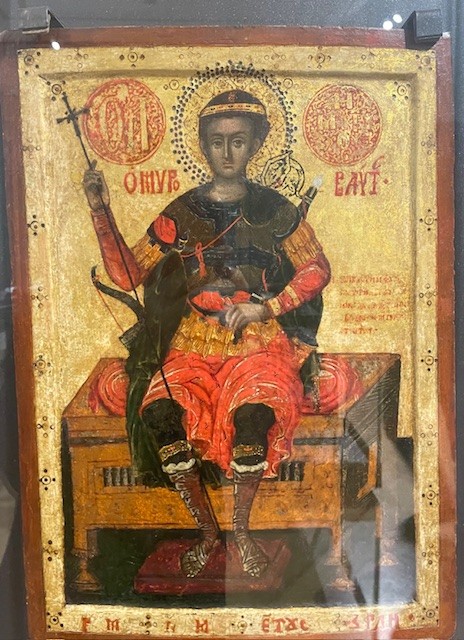
Altın yaldızlı fonda taht üzerinde oturan, kırmızı tunik ve zırh giymiş genç bir savaşçı aziz; sağ elinde iman haçı, sol elinde kılıç kabzası tutmakta, yüzü cepheden bakan bu figür, Doğu Ortodoks ikon geleneğinin zafer ve koruma temalarını Batı’nın natüralist detaycılığıyla birleştirmektedir.
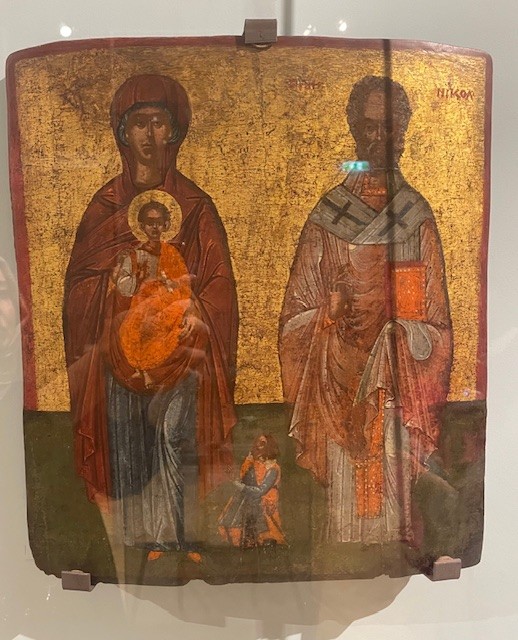
Bu ikona, altın yaldızlı bir fon üzerinde yan yana duran Meryem Ana ve kucağındaki Çocuk İsa ile sağında haçlı omuz şalı taşıyan bir piskopos azizi betimler. Meryem Ana, kırmızı örtüsü ve koyu mavi tunik giysisiyle Theotokos geleneğine uygun şekilde resmedilmiş olup, kucağındaki İsa sağ eliyle takdis işareti yaparken sol elinde muhtemelen bir İncil tutmaktadır. Sağ taraftaki piskopos aziz, kısa sakalı, omuz şalı üzerindeki haç motifi ve kapalı İncil kitabıyla tanınır; muhtemelen St. Nikolaos veya benzer bir piskopos azizi temsil eder. Figürlerin ayakları yeşil zemin üzerinde durur, bu detay dünyevi alan ile kutsal mekânın sınırını vurgular. İkili figürün alt kısmında, ortada diz çökmüş daha küçük bir figür yer alır; bu, ikonayı sipariş eden bağışçıyı ya da dua eden bir mümini simgeler. Figürlerin simetrik ve cepheden duruşu, altın arka planın kutsallığı ve kırmızı tonlu ince gölgelendirmeler, Bizans ikon geleneğinin Italo-Kritik atölyelerde Rönesans detaycılığıyla nasıl harmanlandığını açıkça gösterir.
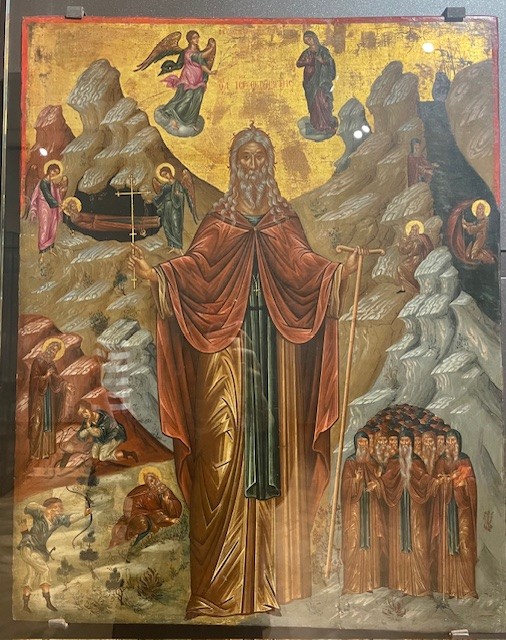
Bu ikona, dağlık bir manzara önünde büyük boy betimlenen bir azizi, muhtemelen ermiş bir keşişi merkez alır. Uzun sakallı, başı hale ile çevrili bu aziz, geniş kahverengi keşiş cübbesi giymekte ve iki elinde bir haç ve asaya benzeyen uzun bir değnek tutmaktadır; bu, hem ruhani liderliği hem de iman mücadelesini simgeler. Arka plandaki altın yaldızlı fon kutsal mekânı vurgularken kayalık dağlar sahneye derinlik ve anlatı katmaktadır. Üst kısımda melek figürleri ve minyatür peyzaj sahneleri yer alır; bunlar azizin yaşamındaki mucizeleri veya ilahi ilham anlarını temsil eder. Sol alt köşede, muhtemelen bir yılanla mücadele eden ya da günahlarından arınan küçük figür, azizin mucizevi gücünü ve şefaatini anlatır. Sağ alt köşede ise bir grup keşiş, liderlerine dua eder pozisyonda resmedilmiştir. Tüm kompozisyon, figürlerin cepheden duruşu, yüzlerdeki ince gölgelendirmeler ve anlatı detaylarıyla Italo-Kritik ikon geleneğinin Bizans derin maneviyatını Batı resim sanatıyla nasıl birleştirdiğini gözler önüne serer.
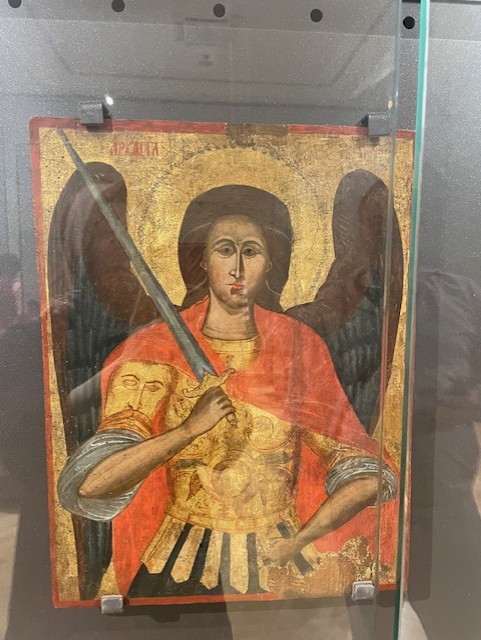
Bu ikona, altın yaldızlı bir fon önünde dimdik duran ve cepheden betimlenen bir başmelek figürünü gösterir; muhtemelen Mikail Başmelek’tir. Figürün başı etrafında ışık halesi bulunur, sırtında ise iri koyu kanatlar dikkat çeker — bu, başmeleğin cennet ordusunun lideri ve ilahi koruyucu rolünü simgeler. Başmelek, zırhlı bir göğüs zırhı ve kırmızı bir pelerin giymekte olup, bir elinde yukarıya doğru kaldırılmış kocaman bir kılıç tutar; bu, onun kötülükle mücadelesini, Tanrı’nın adaletini ve kudretini temsil eder. Diğer elinde ise genellikle zırhı kavrayan ya da bir küre, bazen de bir kalkan tutan bir duruş görülür — burada zırhın detayları öne çıkmakta, figüre askeri bir güç hissi katmaktadır. Kanatların karanlık rengi, altın zeminle çarpıcı bir kontrast oluşturarak meleğin dünyevi mekândan ayrılıp semavi bir varlık olduğunu vurgular. Yüz ifadesi ciddi, gözler izleyiciye doğrudan bakarak bir tür ilahi uyarı ve koruma hissi uyandırır. Bu tarz başmelek ikonaları, Bizans geleneğinde ve Italo-Kritik okullarında, iman topluluğunu kötülükten koruyan manevi savaşçıyı betimleyen en önemli imgelerden biri olmuştur.
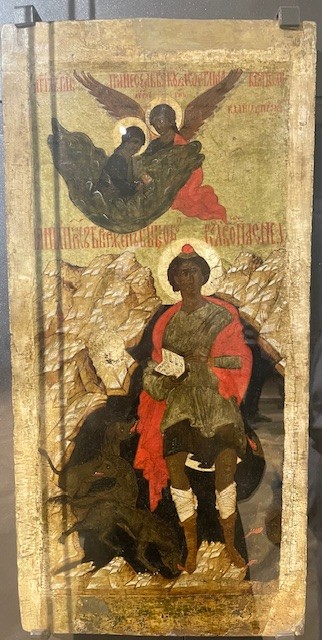
Bu dar ve uzun formdaki ikona, dramatik bir mucize veya azizlik sahnesini anlatır. Kompozisyonun üst bölümünde bulutlar içinde oturan ve ellerini dua pozisyonunda açmış bir aziz figürü yer alırken hemen yanında bir melek figürü bulunur; bu sahne göksel onay ve ilahi koruma anlamı taşır. İkonanın alt bölümünde ise merkezde genç, sakalsız bir aziz veya ermiş betimlenmiştir. Aziz, kısa tunik ve pelerin giymiş, bir elinde dua kitabı veya parşömen tutarken diğer eliyle bir jest yapmaktadır; bu, öğretiyi yayma veya mucizeyi gerçekleştirme anlamına gelir. Ayaklarının altında karanlık tonlarda betimlenmiş, zincirlenmiş veya yere bastırılmış canavar figürleri dikkat çeker — bu detay, azizin kötü ruhları veya şeytanı alt etmesini simgeler. Kaya dokulu arka plan, figürün mağara veya dağlık bir çilehane ortamında yaşadığını ima eder. Üst bölümdeki melek, azizin göksel ilham aldığını ve eyleminin kutsandığını vurgular. Parlak kırmızı vurgular, pelerindeki kırmızı ve göksel sahnedeki melek detayı, Bizans ve Italo-Kritik ikonografisinde ruhani zaferin ve kan bağı pahasına korumanın sembolüdür. Bu sahne, izleyiciye azizin hem dünyevi kötülüklere karşı direnişini hem de Tanrı’ya bağlılığını bir bakışta anlatır.
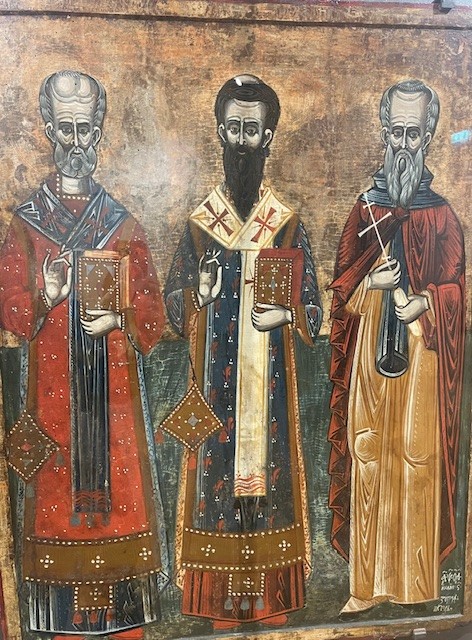
Bu ikona, cepheden ve simetrik biçimde yan yana dizilmiş üç piskopos azizi tasvir eder. Her biri başında altın yaldızlı bir hale taşır ve ellerinde kapalı İncil kitabı tutarak Ortodoks inancının öğretisini simgeler. Figürlerin sağ elleri takdis işareti yapar; bu, kutsama ve duaların kabulünü temsil eder. Sol figür beyaz sakalı, ince yüz hatları ve kırmızı ağırlıklı giysisiyle yaşlı bir azizi betimlerken, orta figür siyah sakalı, detaylı pallium (haçlı omuz şalı) ve koyu mavi kaftanı ile güçlü bir patrik figürü izlenimi verir. Sağdaki figür, narin yüzü ve elinde uzun haç benzeri asa veya süslemeli çubuk tutuşuyla daha münzevi bir azizi andırır. Giysilerdeki ince işlemeler, geometrik desenler ve yaldız vurgular Italo-Kritik ikon geleneğinin dekoratif zenginliğini taşırken figürlerin uzun, orantılı yüz hatları ve belirgin gölge konturları Bizans çizgisini korur. Arkadaki koyu zemin figürleri öne çıkarırken, arka planın üst kısmındaki aşınmış doku ikonanın zamanla aldığı patinayı ve tarihsel değerini yansıtır. Üç azizin birlikte sunulması, cemaat için hem şefaatçi hem de öğretiyi koruyan ruhani bir birlik anlamına gelir.
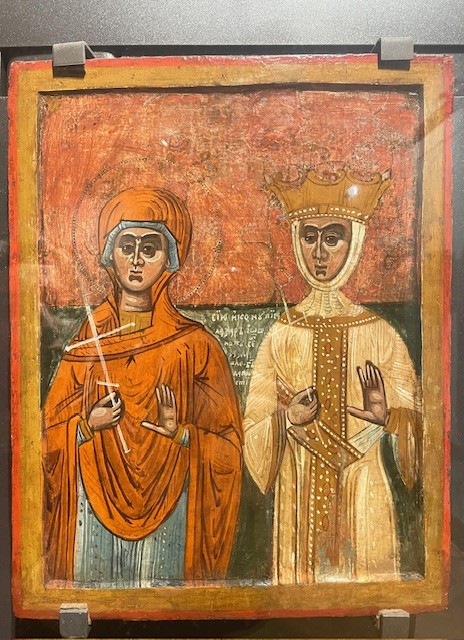
Bu ikona, kırmızı zemin ve koyu yeşil alt bant üzerinde yan yana duran iki kadın azizi tasvir eder. Sol figür, başını örten örtüsü, sade tunik ve kolları çaprazlayarak kavradığı kılıçla bir şehit azizi simgeler; kılıç, inancından ötürü can veren azizelerde sık kullanılan bir şehitlik sembolüdür. Figürün başının etrafındaki ince altın halo, kutsallığını vurgular. Sağ figür ise başında büyük, taşlı bir taç taşır; bu, onun ya kraliyet soyundan bir azize ya da taçlı bir şehit azize olduğunu gösterir. İki figür de cepheden, simetrik duruşları ve kollarını kavuşturmuş halleriyle tam bir manevi vakar ve kutsallık ifadesi taşır. Giysi detaylarında kullanılan beyaz, altın ve kırmızı tonlar, Bizans ikon geleneğinin renk sembolizmini yansıtır: kırmızı şehitlik, beyaz saflık ve ilahi zafer anlamı taşır. Figürler arasındaki yazıtlar azizlerin isimlerini ve kısa duaları içerir. Arka planın dokulu, kiremit kırmızısı boyası ikonaya dramatik bir derinlik katarken, ince kontur çizgiler ve figürlerin uzun yüz hatları Italo-Kritik atölyelerinin karakteristik üslubuna işaret eder. Bu sahne, kadın azizlerin hem dünyevi asaletini hem de ruhani zaferini bir araya getirir.
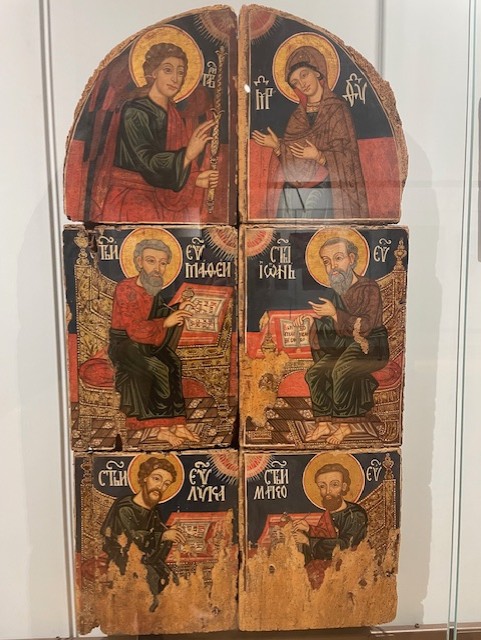
Bu ikona paneli, üstteki iki kavisli bölüm ve alttaki dört kare panodan oluşarak bütünsel bir kutsal anlatı sunar. Üst bölümde solda bir aziz ya da İsa figürü, sağda ise Meryem Ana yer alır; bu ikili figür, klasik “Müjde” (Annunciation) sahnesini çağrıştırır ve Kutsal Ruh’un Meryem’e gelişini simgeler. Alt dört panoda ise Dört İncil Yazarı — Matta, Markos, Luka ve Yuhanna — oturur pozisyonda resmedilmiştir. Her bir evanjelist, dizinin ortasında cepheden bakar, sağ elleri yazı işaretini veya dua jestini yapar, sol elleri ise kalem ya da açık İncil kitabı tutar; bu sahne onların Tanrı sözünü dünyaya aktarma görevini simgeler. Giysilerde kırmızı, yeşil ve altın detaylar, hem Bizans ikon sanatının hem de Italo-Kritik atölyelerin tipik renk düzenini yansıtır. İncil yazarlarının arkalarındaki koyu mavi fon, figürlerin öne çıkmasını sağlarken işleme benzeri desenler göksel mekânı simgeler. Alt kenarlarda görülen aşınmalar, ikonanın yüzyıllar boyunca ibadet ve öpücük pratiğiyle nasıl kullanıldığını gösterir. Bu bütünsel düzen, Ortodoks ikonografisinde Kutsal Kitap’ın göksel kökenini ve dört müjdecinin metin yoluyla İsa’nın hayatını nasıl yaydığını hatırlatır.
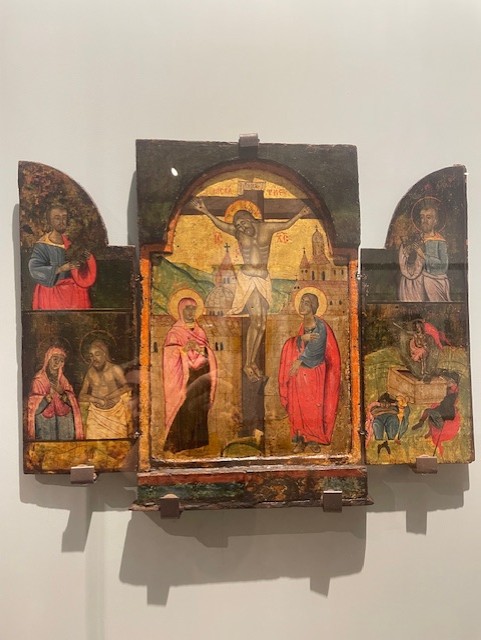
Üstteki üç kanatlı ikona, Bizans ve Italo-Kritik ikon geleneğinde sıkça görülen Deesis (Şefaat) kompozisyonunun zengin bir örneğidir. Orta panelde İsa Pantokrator (Hâkim İsa) yüceltilmiş bir tahtta oturur, sağ eliyle takdis işareti yapar, sol elinde açık İncil tutar. Hemen sağında Meryem Ana, solunda Vaftizci Yahya figürü yer alır; ikisi de başlarını İsa’ya dönerek şefaat pozisyonunda ellerini açmışlardır. Yan kanatlarda farklı azizler, melekler veya aziz sahneleri yer alır; örneğin sol üstte savaşçı aziz, alt köşede ejderhayı öldüren Aziz Georgios betimlemesi dikkat çeker. Kompozisyonun kırmızı bordürleri, koyu arka planlar ve altın yaldız detayları, bu sahnenin kutsallığını vurgular. Alttaki küçük panelde ise Meryem Ana, taht benzeri bir kürsüde oturur ve kucağında Çocuk İsa’yı tutar; yanında ayakta duran bir aziz figürü ona eşlik eder. Zemin perspektifli karo döşemesi, mekâna derinlik hissi katar. Bu iki panel, Ortodoks ikonografisinin temel figürlerini — Hâkim İsa, Şefaatçi Meryem, Vaftizci Yahya, savaşçı azizler ve koruyucu piskoposlar — tek bir anlatıda bir araya getirerek izleyiciye hem dua hem de koruma amaçlı bir kutsal pencere sunar.
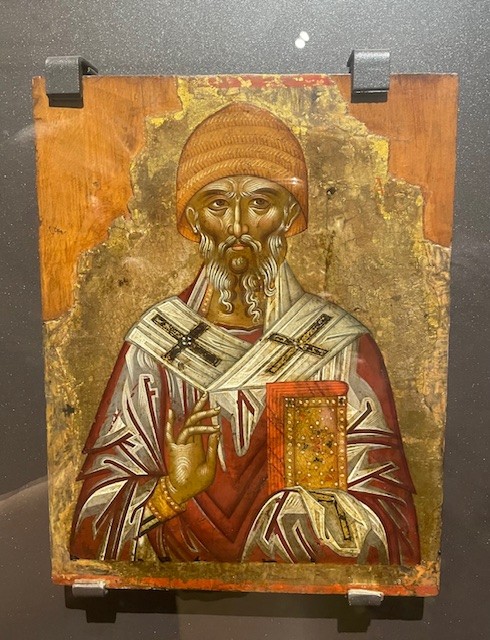
Bu ikona, altın yaldızlı arka plan önünde cepheden duran yaşlı bir piskopos azizi betimler. Figürün yüzü ince, sakalı uzun ve dalgalıdır; bu, genelde Aziz Nikolaos veya Aziz Spiridon gibi saygın bir piskoposu akla getirir. Başında geleneksel bir keşiş başlığı veya örgü bereye benzeyen sade bir örtü vardır, bu da onun hem piskopos hem de manastır geleneğine bağlı bir aziz olduğuna işaret eder. Omuzlarında çapraz bağlı pallium (haçlı omuz şalı), episkopal (piskoposluk) rütbesini gösterir. Sağ eli, klasik takdis (kutsama) işareti yapar; bu, hem İsa’nın öğretilerine bağlılığı hem de cemaatin dualarına aracılık etme yetkisini simgeler. Sol elinde ise detaylı taş süslemeli, kapalı bir İncil kitabı taşır; İncil’in kapak motifleri ikonanın zengin işçiliğini ortaya koyar. Yüz hatlarındaki koyu çizgiler, dalgalı sakal ve ince gölge geçişleri, Italo-Kritik atölyelerin Bizans mirasını Rönesans detaycılığıyla harmanladığını gösterir. Arka planın altın varaklı dokusu, figürü dünyevi mekândan kopararak zamansız, kutsal bir boyuta yerleştirir. Bu ikon, Ortodoks geleneğinde piskopos azizlerin inananları hem koruyucu hem de dua şefaatçisi olarak nasıl temsil ettiğinin güçlü bir örneğidir.
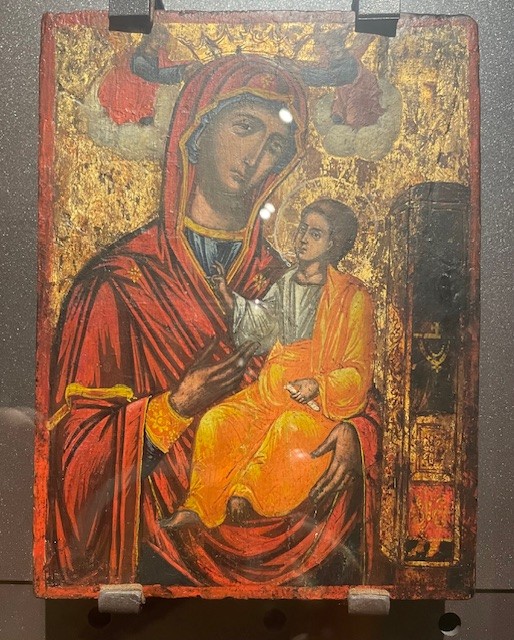
Bu ikona, altın yaldızlı bir fonda cepheden, kucağında Çocuk İsa’yı taşıyan Meryem Ana’yı betimler. Meryem, başını hafifçe sola eğerek Çocuk İsa’ya sevgiyle bakarken izleyiciyle de manevi bir bağ kurar; bu duruş annelik şefkatini ve Tanrı’nın lütfunu sembolize eder. Meryem’in kırmızı maforionu (örtüsü) ve koyu mavi iç tuniği, Ortodoks geleneğinde saflık, kraliyet ve kutsallığın renk kodlarını taşır. Başının etrafındaki ince altın halo, Tanrı’nın annesi olarak kutsal rolünü vurgular. Çocuk İsa ise sol elinde bir parşömen veya İncil tutar, sağ eliyle takdis işareti yapar ve parlak altın-sarı tonlarda bir tunik giymiştir; bu ayrıntı, İsa’nın hem dünyevi bedenini hem de ilahi bilgeliğini simgeler. İkona yüzeyindeki altın zemin, figürleri dünyevi mekândan ayırarak zamansız bir kutsal boyuta taşır. Meryem’in başının üstünde görülen kırmızı melek kanatları veya figüratif detaylar, sahneyi göksel varlıklarla çevreleyerek onun ilahi konumunu pekiştirir. Figürlerin ince konturları, canlı renk geçişleri ve hafif perspektif vurguları, bu eseri Italo-Kritik ikon atölyelerinin Bizans kökenli derin maneviyatı Batı resminin renk zenginliğiyle harmanladığının güzel bir kanıtı haline getirir.
Bu ikonalar, İstanbul’dan taşınan bir gelenekle Venedik atölyelerinin birleştiği nadir örneklerdir. Hem Ortodoks cemaatlerin maneviyatını taşır hem de Batı Avrupa’nın sanat anlayışına uyum sağlar. Bu nedenle Italo-Kritik ikonlar, Balkanlar, Girit ve İyonya Adaları’ndaki manastırlarda yüzyıllarca üretilip ticareti yapılmıştır.
Kısacası, İstanbul’un fethi sonrası bu zanaatkâr göçü, sadece bir yer değiştirme değil; sanatın, kimliğin ve inancın yeni coğrafyalarda nasıl kök salabileceğinin çarpıcı bir örneğidir.
Kaynakça
- Cormack, R. (1997). Byzantine Art. Oxford University Press.
- Mango, C. (1986). The Art of the Byzantine Empire. Prentice Hall.
- Belgrad Ulusal Sanat Müzesi Panosu: “Italo-Cretan Icons” Açıklama Metni.
Dr. Hümeyra Türedi
Fotoğraflar: Dr.Hümeyra Türedi – Belgrad Ulusal Sanat Müzesi